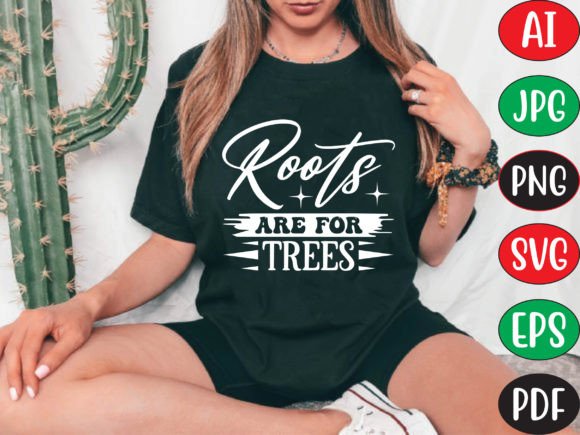
Roots Are for Trees: Graphics for T-Shirt Designs
When I first opened the Roots Are for Trees file set, I immediately got the sense this wasn’t a generic, thrown-together collection. It arrived as a 100-editable-file package — Ai, EPS, SVG, PDF, PNG, and JPG formats, all well-organized — and the high-resolution 300 dpi PNGs with transparent backgrounds instantly told me the creator understands what a serious seller needs. There’s a high-quality mockup included too, which saves me a step. The mood leans toward nature-inspired, a little rustic yet modern enough to sit on a trendy t-shirt design or a clean printable wall art piece. It has that handmade, decorative warmth that attracts buyers looking for something personal, not mass-produced. I could see it resonating with an audience that loves botanical whimsy, family-themed gifts, or slightly earthy humor — the kind of buyer browsing Etsy for a sentimental mug or a nursery print.
The visual personality of Roots Are for Trees sits in a comfortable middle ground: it’s elegant enough for a premium digital download, but playful enough for a casual Cricut project. The tree-root imagery feels grounding and authentic, which works well for branding that wants to feel genuine. As I scrolled through the editable files, I saw the 100 color-changeable promise really holds up — switching a leaf shade or root tone takes seconds in Ai or EPS, which means you can adapt it to a dozen product themes without restarting. For my shop, where I test assets across seasonal bundles, this flexibility is non-negotiable. The transparent backgrounds on the PNGs are pixel-clean, and the included JPG with a mockup gives me an instant preview option for listing images.
First Test: Building a Product Line Around the Design
I ran my usual test by picturing a real shop scenario: I’m preparing a new “Nature & Nurture” collection for my Etsy print-on-demand store and a matching digital download set for Creative Fabrica. Roots Are for Trees needed to prove it could stretch across merchandise, templates, and printables without losing impact. I started with the SVG. I uploaded it into Cricut Design Space — the cut lines were crisp, no unnecessary nodes, and it weeded cleanly on a test vinyl project. This immediately told me I could safely create sticker designs, iron-on transfers for tote bags, or even a layered cardstock project for a scrapbooking kit. The illustration’s balance means it won’t overwhelm a small sticker, but I’d still test a two-inch version before committing to a sticker sheet to ensure tiny root details hold.
Next, I dragged the high-res PNG into a Canva template. I placed it over a mockup of a unisex t-shirt. The design scaled well, held its edge contrast on both dark and light backgrounds, and the mood shifted subtly depending on whether I paired it with a serif font (for a classic look) or a handwritten script (for something softer). The visual hierarchy stayed intact — the roots didn’t get lost in the garment folds, and the transparent background meant no awkward white boxes. For a print-on-demand seller, that’s half the battle won.
Where the Asset Truly Shines
After a full afternoon of testing, I found several high-confidence applications. Roots Are for Trees excels in t-shirt designs that benefit from a centered, symbolic graphic — think front chest prints or back shoulder placements. It also works brilliantly for printable wall art. Because the PNG and JPG files are 300 dpi, you can scale it up for a clean 8x10 or A4 print without losing clarity. I’d comfortably use it for mug designs (the mockup included gave me a head start), tumbler wraps, and tote bags. The design reads well at a glance, which is critical for marketplace thumbnails where a buyer scrolls fast. As a commercial design asset, it could anchor a seasonal bundle — autumn, Earth Day, or a family-themed gift set — or sit beautifully on a greeting card front.
For digital product creators selling Canva templates, this asset can become a reusable anchor illustration. Place it on a social media template, a blog graphic, or a digital paper pack accent, and it elevates the perceived value instantly. The color-editable feature is a cheat code for brand identity: adjust to match a pastel nursery palette one day, a moody forest vibe the next. I even tested it as a sublimation design on a mockup for a ceramic tile, and the rustic roots looked convincingly handmade. For my shop, this meant I could create not one, but at least seven distinct product types from a single purchase.
Practical Considerations Before You List
No asset is perfect for every use case. I learned early in my digital selling journey that ignoring weak spots leads to refund requests. With Roots Are for Trees, caution is needed for very small applications. If you’re creating tiny sticker details — say, a multi-sticker sheet with designs under 1.5 inches — the intricate root lines might blur at print resolution. Test on your specific sticker paper and printer first. Similarly, if you’re building a text-heavy template, the design could compete with the message rather than enhance it. I’d reserve it for layouts where it serves as the hero element, not a subtle background element on a dark-colored page where contrast disappears.
For Cricut and Silhouette users, the SVG is clean, but always do a test cut on the material you’ll ship. Vinyl cutting was flawless, but when I tried a cardstock cutting on an intricate setting, some fine root tips lifted slightly — a mat issue, not a file issue, but worth noting for crafters who might not anticipate that. Also, if you sell on platforms with strict thumbnail guidelines, the design’s relatively organic shape means you’ll want to add a subtle border or background in some listing images to ensure the silhouette is clear at small sizes. The packaging of files for customers is straightforward, but I’d suggest creating a “preview” folder inside your final download to showcase the design on different mockups, making the purchase feel more curated.
Working the Files Into a Customer-Ready Product
Opening the Roots Are for Trees package, you get exactly what you need to move quickly. The editable Ai and EPS files allow you to recolor vectors without rasterizing, which kept my workflow seamless when adapting the design for a client’s brand colors. The PDF is handy as a bonus print-ready file. The PNGs have transparent backgrounds and hold sharpness even when I layered them over textured paper backgrounds in Photoshop. The included high-quality mockup saved me thirty minutes of searching for the right t-shirt preview, and it’s realistic enough for a listing image with a little additional lighting adjustment.
Here’s a quick checklist I used after testing, and I recommend any seller run through this:
- Open the SVG in your cutting software of choice and simulate a cut.
- Place the PNG on a white mockup, then a dark mockup, and check edge clarity.
- Test-print a small section of the design at 300 dpi to confirm colors match your screen — some eco-inkjet printers may mute the greens.
- Try the design paired with a serif font, a sans serif, a script, a handwritten, and a display font to see which mood sells best for your niche.
- Verify commercial licensing terms before use on print-on-demand physical products or digital resale assets; most seller-friendly assets allow this, but always confirm.
- Organize customer download folders logically: separate “Editable Files,” “Print Files,” “Mockups,” and “Licensing.”
The Real Value for a Creative Entrepreneur
What sets Roots Are for Trees apart in my workflow is its adaptability without me needing to spend hours refining. I’ve tested many clipart assets that require constant node cleanup or look flat on garments. This one has enough depth and organic texture to feel like a custom illustration, yet it’s simple enough to work as a repeatable product template. For a small business owner building a handmade brand, the design’s wholesome mood aligns with storytelling marketing — you can build an entire product narrative around roots, growth, and connection. I saw immediate potential for a line of baby onesies, a tumbler for mom, and a downloadable nursery print, all with a color-harmonized look that strengthens brand consistency.
From a product presentation standpoint, the visual storytelling is strong. The design on a mockup telegraphs meaning quickly, which improves click-through potential on crowded marketplaces. I placed it as the hero graphic on a digital download listing image, and it immediately clarified the theme without extra text. For social media graphics, it became an evocative accent — I sized it as a corner element in a blog header, and it pulled the composition together. If you’re building multiple packs — say, a “Forest Family” bundle — this asset could be the anchor illustration you build others around.
But I’ll be honest about one thing: an asset like this demands you curate the surrounding designs carefully. Because the roots aesthetic is distinct, a mismatched font or an aggressively bright secondary graphic can break the spell. Treat it as a premium design piece, and it will lift a product; treat it casually, and you risk a generic-looking listing. That said, with the included mockup, transparent PNGs, and editable vector files, Roots Are for Trees is more than ready to become a reliable workhorse for your printable design shop, t-shirt collection, or digital download catalogue.